As the Interpretive Tour Guides we got a 'primo' parking site: next to the Museum where the tours commenced. Out or back picture window was the Admiralty Inlet - the only deep-water connection between the Pacific (thru the Strait of Juan de Fuca) and Puget Sound. The ship traffic was never-ending and included nuclear subs, Navy ships headed to Bremerton Shipyard, cruise ships out of Seattle and lots of ferry traffic and pleasure boaters. I never tired of it. The weather was just about as changeable and the cold fogs (that's one rolling in on the lighthouse, below) added a new dimension for us.
The main body of the Fort and our rig in the picture above are about a 100 feet above the water. The old lighthouse shown here was right at the point and all downhill. It is now operated as a Research Center by NOAA but still used by the State Park guests, as well as locals who love wade-fishing here. The twice-a-day tide changes create unbelievable currents and that makes it a great 'fishing hole'. More on that later.
The property the State of Washington got from the Army back in 1952 to make this a state park included a lot of land that was still wooded - and even a beach site on the back bay. This is where the campgrounds are located and they are in deep, old forests and really nice. Many of the workampers were sited here as Park Hosts. There were neat trails to hike or bike and you could 'get away from it all' on these trails.
Some of the Workamping Team - most of whom have come back here for years - partly for the area and also for the chance to work with a great management team led by Ranger Manager Mike Zimmerman. Here we are laying out a potluck meal - note the festive 'summer' attire - it is as far North and West as you can go.
Monday, June 16, 2014
Fort Flagler State Park - August 2013, part 1
Our Workamping site for the Washington State Parks.
We were called and asked to fill in in August as the Historical Interpretive Guides at
this is very old, popular park that has been used for generations by area families who still love it.
After we didn't need 'study time' we filled in our 32 hours (total, together) a week with other activities.
Below is Ava helping the rental housing (barracks) by sewing up new curtains - the existing ones were rags! She enjoyed doing this and no one else could, or would, do it. I filled out my hours by doing housekeeping maintenance for these same old barracks that stayed full all summer with family reunions, HS band camps, and church groups. Most weeks there was hardly any 'turn-around' time before the next big group came in!
Sunday, June 15, 2014
Whale Watching from Victoria, British Columbia - July 2013
This is the boat I chartered to take Ava to see the Orcas.
I spare no expense for My Girl!
(It's the little aluminum one in the foreground :) (( the big
fiberglass one was on it's maiden voyage and unavailable))
Size doesn't matter (in boats) but the big Orca was the matriarch
and she had quite a following. This pod was really puzzling the
experts on board until they called around to the other boats and
figured out this was not a local pod but a sea-going family group.
They don't mix - the locals eat only salmon and the transient Orcas
only eat seals and sea lions.
There were people watching from this island (one of the San Juans)
and even launching kayaks to get a closer look. They had quite
an audience and we were thrilled to be among them!
Victoria, BC is a beautiful city on Vancouver Island and we saw it on a perfect-weather day!
A Logging Tour on the OP - July 2013
We were told to not miss this tour by the good folks managing our park in Port Angeles.
They were right - it was worth the wait and the drive. Here in Forks (Twilight, anyone?)
the rain gauge is in feet, not inches. I am pointing at the 5-foot mark and it goes to 12f!!
So far, a dry year but the real rainy season is coming. We had a driver who was a logger
for 40 years and a guide who worked for the Washington Dept of Natural Resources managing the state's timber lands - very knowledgeable pair.
Our first stop was at one of last specialty mills in the area - the logging industry has been
hard hit and this mill was fascinating. It took these logs and with BIG automation cut them
down to 2x4s, 4x4s, etc. It was unusual to get to visit a working mill, so we felt fortunate.
Next stop was viewing the actual logging (from a safe distance). These machines
dragged the felled trees out to a clearing then stripped, picked up and loaded them.
This tries to show how the forest is managed - like a patchwork quilt some areas
are cut, others left for a later time. Every cut-over area has some trees left in it
and some areas require a mot of trees to harbor wildlife. Seedlings are planted on
all cut acreage. We came away thankful that this valuable work is still going on.
Want to invest your retirement acct in wood? Be prepared to wait 40 to 50 years
for the payback!
Last images from the woods of the OPNP
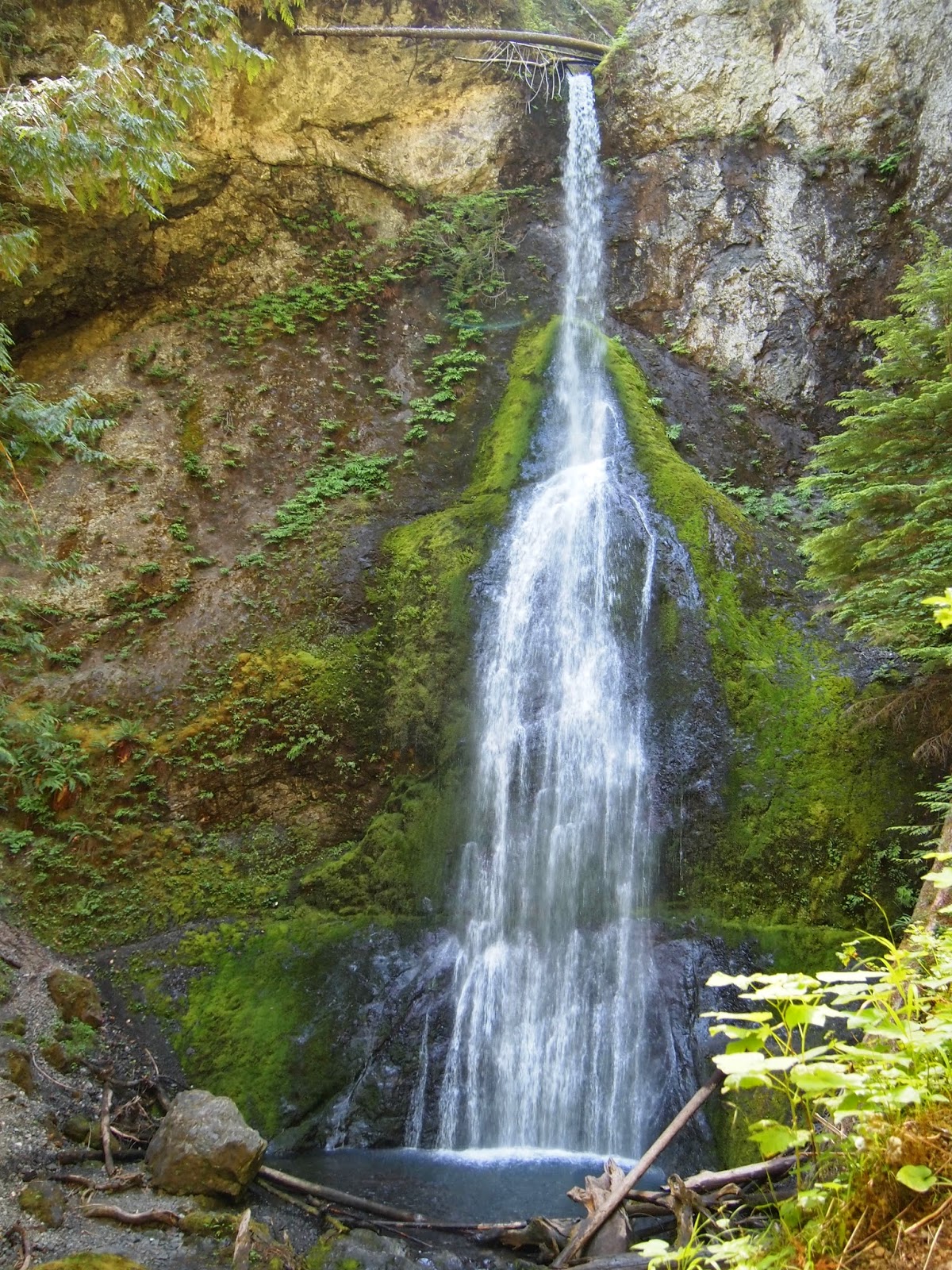
Big trees need lots of water and that also meant great hikes to waterfalls like this.
Probably what the Ents looked like to Merry and Pippin! Us, too.
Sometimes you sense that the trees and rocks need our help to stay standing.
My own wood elf - can you tell she loves the trees?
Thursday, June 5, 2014
Finally, Cape Flattery
After a 6 hour drive, it is 1/2 mile hike to the water!
This is the northwestern most point of land in the lower U.S.
| Sea Lion asleep on the rocks. Also thus is on the Pacific Flyway for more than 250 species of birds! |
This is a remote area with one road in and one road out. It was breathtaking in every way and a spectacular day for the trip! The sound of the waves crashing on the rocks below and the birds made it hard to be heard when talking.
Thursday, August 29, 2013
On the Way to Cape Flattery
Crabbing!
Here a couple of young guys who worked for Washington Fish & Wildlife showed off their mornings catch. Three hours of walking the mudflats and they had 4 Dungeoness crabs.
Farther down the road you find the little fishing village of Seiku (seek-you). It comes alive in July and August when the salmon run comes through this entry to the Strait of Juan de Fuca.
We had to stretch our legs and walk the docks to see who was bringing in fish. We did see one really nice King salmon - probably 20 pounds. Only fish for the day's trip, apparently (don't ever ask what the 'cost per pound' is:). Wanted to show this very typical fishing boat: all marine aluminum, lots of power and protection against the weather - but not much space. Saw one ( used) for sale - at only $81,000!! Probably they last a long time and they are obviously very seaworthy. Our whale-watching tour boat was just a larger version of this.
Wednesday, August 14, 2013
Going to the Beach - NW style
Well, it was another hike. On an Indian reservation with minimal improvements the trail went up, then down, then up again over a ridge.
As you can see it was an old-growth forest full of fern and moss and really dark and dank - but beautiful.
Then you break out of the trees and see - an amazing rocky, log-strewn, wide flat beach.
Not like our So Tx beach, to be sure but there were a lots of beachwalkers and even a few hardy souls who had set up a beach camp.
Wanna try this beach, Dennis, for your next beach camp?
As you can see from the logs strewn about and the wave-chewed promontory this is no beach for the faint-hearted, or a winter campout - when most of their storms toss these logs up against the bluff.
Does it look a bit cool and wintery? It was - and this is in mid-July!
One of my best pics ever.
Ava is sending her greetings to you all from this special beach - one about as far north and west as you can go and actually find one to walk on in the 'lower 48'!
Wednesday, August 7, 2013
OPNP - Hoh Rain Forest
Under the enormous Spruce, Hemlock, Cedar, Fir and Maple are ferns and mosses of every type. Nothing that grows is harvested here in the NP, and nothing that falls is wasted by nature. Many of the young trees were found growing out of the fallen ones. Only the strongest survive some of the winter storms they get here.
A Ranger shared that recent tests of the trees with radioactive isotopes proved that within 24 hrs moisture and nutrient could be absorbed by leaves on one tree and transferred by roots to trees a hundred yards away! (Maybe the movie Avatar was on to something?!!)
The rapid and unfettered growth - and the way trees too close together are absorbed into one - makes for really eye-catching shapes.
My eye is always caught by this particular shape:)
Ava thought this looked like Ent Gary.
I wasn't so sure - I tend to wear my hair shorter now,
Olympic Peninsula - Port Angeles
The last weekend of June we arrived at View Vista Park - and it was well named. Only five RV sites, the rest being exceptionally well-manicured mobile homes - and yards!
Did I mention the vistas we viewed? This is what we looked at downhill, and down-mountain, from our RV site. That's the Strait of Juan de Fuca that separates us from Vancouver, BC, Canada.
This strait connects directly to the Pacific, varies from 5 to 20 miles wide and is the 'weather-maker' for these coastal towns. Always cool, often foggy and always beautiful.
Two of the north entrances to OP National Park are almost in Port Angeles (PA to the locals) and this one popular: Hurricane Ridge. 17 miles of winding mountain road to almost 8,000ft elevation and what spectacular views of this vast park to the south. Here we are looking at the heart of the Olympic mountain range. Snow covered all year due to the ocean moisture, high elevations and daytime temps that seldom reach 70 degrees.
When you look north you have snow at your feet, PA on the coast, the Strait and Vancouver Island in the distance. On really clear days you see Mt Baker with it's massive mantle of snow.
Everywhere we drove - and its a massive place to try to see- the views were jaw-dropping. I never tired of it.
Thursday, August 1, 2013
Making our way West on the Oregon Trail
The next day Ava and I worshipped in Jerome, Idaho in a log cabin church that Sojourners helped build almost 20 years ago!
Following the Yakima River we camped below the pass leading through the Cascades and marvelled at the abundance of cherry orchards, apples, peahces and pears - as well as scores of vineyards. These cherries were "pick all you want for a $1 a bag!
Our campground was on a "working ranch" - and I wondered at the stock I was seeing - all bulls!
Then I found out the rancher leased his pasture out to a man who provided bulls for Bull Riding in Rodeos! If I was even thinking about crossing the fences that thought was now banished!
Next stop - the NW Washington coast!
Subscribe to:
Posts (Atom)